Not that anyone noticed I was gone... but I did have a decent reason. My grandfather was in the hospital for ten days shortly after Christmas and my father has been in the hospital for the past three weeks or so following a large car wreck. We hope he'll be able to come home in the next day or two.
My uncle came out from California yesterday. He will be staying for a little less than a week and helping us both get dad settled back in and do some work on the property.
One of the projects will be a fence. As I mentioned in my previous post I'd like to plant some alfalfa in the garden field. However when I take the goats for a walk they run through that field on the way back. Not only would they trample the plants, they'd probably also gorge. So the long and short of it is that I'm going to build a nice fence at one end of the field. Tobe will be helping me set the posts.
We'll also be moving the chicken fence to the base of the slope it's on now. The hillside's been getting eroded...
Well that's it for now.
M.
Thursday, February 9, 2012

Monday, January 9, 2012
My thoughts and plans and deepest secrets...
Well... not really... I just thought I'd write something quickly before I went to bed. The weather for the past few days has been awful and it has given me time to think. And now writing a book on working goats and thinking about raising meat rabbits.
I called Harry today while I was at school (school has started again by the way) and he will be coming out when it dries up to plow a section of the land so we can plant an alfalfa mix. I'm planning to sell the hay to a friend who has a milking doe and I think the alfalfa's strong root system might improve the soil since MSD (local sewage department) messed it all up.
I'm not sure if I've posted about Harry before... he is a retired army mechanic who helped us harvest hay for the first time last year. I'm so grateful.... The hay is beautiful, the goats are wasting next to nothing and there should be enough to last us through to the next cutting.
Dad has cleaned up the barn beautifully and I hope to set up a station for reading fecals soon.... maybe I'll do a post on that :)
That's all for now... I have to be at class at eight and so I mun to bed.
M.
Wednesday, January 4, 2012
Pretty goats!!!
Just thought I'd post this site quickly. So many pretty goats! I'll be back later. :)
http://nigeriandwarfcolors.weebly.com/index.html
M.
http://nigeriandwarfcolors.weebly.com/index.html
M.
Thursday, December 22, 2011
Oh Christmas Tree...
For the past few years my family has cut our own tree from the property. We have a fairly large number of yellow scraggle pines. Today we went to get the trees. One for my grandparents and one for us. The one for the grandparents is fairly small. Small enough that I carried it back on my shoulder. Ours on the other hand is really very large. Large enough that it would have been time consuming and unpleasant to drag it back by hand. So I decided to pull it by goat. I got the two of them out, unbolted the double-tree from the cart, got plenty of rope and the two breastcollars from the harnesses and set out.
I was worried that the goats would try and eat the tree but they were good. They both tried to eat it once or twice but when I sent them away they happily ate the honeysuckle elsewhere. It took maybe 15-20 minutes for me to tie the double-tree to the trunk. I wrapped the rope around the branches, fastened the traces to the double-tree and went to get the goats. They had halters on and let me fasten the leadropes and bring them to the tree. Merry made a bit of a lunge for it but I managed to dissuade them from eating it and they amenably started eating the grass. I got the harnesses on and of we went!
There were some glitches for the first 75-100 yds. Merry's leg got tangled up in the trace, Pippins trace came off a few times, and he didn't pull perfectly consistently but things only got better. By the time we got down from the high field it was beautiful! They were nicely and evenly spaced and walking smoothly in sync. I was so thrilled! We got home and they each got a carrot and I tried to take a photo or two. I unhitched them and put them back in the stall with some nice hay and beet pulp.
It was such a fantastic experience. It made me feel so good about my relationship with the goats and their abilities. Firstly the sheer fact that I can take them out and just do it. Pull a tree. None of us had ever pulled a tree before but it still went well. They didn't freak out about the great noisy thing behind them. I was very proud of Merry when a trace wrapped around his leg and he just tried to keep pulling. If I had been him I'd have gone bonkers! Apparently they are fairly confidant goats. :) And at the end, when they had both finished drinking I pointed and clicked my fingers and they both walked happily and willingly into their pen.
M.
I was worried that the goats would try and eat the tree but they were good. They both tried to eat it once or twice but when I sent them away they happily ate the honeysuckle elsewhere. It took maybe 15-20 minutes for me to tie the double-tree to the trunk. I wrapped the rope around the branches, fastened the traces to the double-tree and went to get the goats. They had halters on and let me fasten the leadropes and bring them to the tree. Merry made a bit of a lunge for it but I managed to dissuade them from eating it and they amenably started eating the grass. I got the harnesses on and of we went!
There were some glitches for the first 75-100 yds. Merry's leg got tangled up in the trace, Pippins trace came off a few times, and he didn't pull perfectly consistently but things only got better. By the time we got down from the high field it was beautiful! They were nicely and evenly spaced and walking smoothly in sync. I was so thrilled! We got home and they each got a carrot and I tried to take a photo or two. I unhitched them and put them back in the stall with some nice hay and beet pulp.
It was such a fantastic experience. It made me feel so good about my relationship with the goats and their abilities. Firstly the sheer fact that I can take them out and just do it. Pull a tree. None of us had ever pulled a tree before but it still went well. They didn't freak out about the great noisy thing behind them. I was very proud of Merry when a trace wrapped around his leg and he just tried to keep pulling. If I had been him I'd have gone bonkers! Apparently they are fairly confidant goats. :) And at the end, when they had both finished drinking I pointed and clicked my fingers and they both walked happily and willingly into their pen.
M.
Wednesday, December 7, 2011
Biology
is amazing. The reason I'm posting about it is that I think it might interest you if you are into sustainable agriculture. Depending on how would you define sustainable agriculture. I agree with the definition in my biology book: farming methods that are "conservation-minded, environmentally safe, and profitable" I would also add local to this because it takes into account the fossil fuels consumed in transport of goods.
This chapter was on plant nutrition. The essential elements that plants require and how environmental factors effect them. Did you know that a deluge of rain is more likely to wash away negatively charged ions (e.g. sulfate ions) than positively charged ones? This is because they are bound less tightly to the slightly negative soil particles and likes repel like. This also means that positively charged ions are more complicated for plants to get. They have to release hydrogen ions (also positively charged) to replace and release the many bound ions they need for nutrition (including calcium, potassium, and magnesium.) Acid rain has the same effect of putting hydrogen ions in the soil and will deplete the soil of positively charged ions as well as negative ones that normal rains affect.
If a plant is deficient for a mineral chances are it is nitrogen. Various plants get it in different ways but one thing that amazed me was the system that legumes have developed. You know when you put that black stuff on peas before planting them? I had never realized but what you are doing there is rolling the seed in bacteria so that it will be infected from the get-go. This bacteria is called Rhizobium and it is the reason that legumes are often known as "nitrogen fixers" (meaning that they take atmospheric nitrogen and make it available in the soil.) The legumes have nothing to do with the fixing. It is the nodules on their roots that are formed by and contain a strain of nitrogen-fixing bacteria that do this. This symbiotic relationship gives the plant nitrogen and the bacteria organic nutrients that the plant synthesizes during photosynthesis. The infection takes place after a longish molecular "conversation" between the two organisms which leads scientists to hope that, with greater understanding of the process they could "learn how to induce Rhizobium uptake ... in crop plants that do not normally form such nitrogen fixing symbiotic relationships" which would lead to less need for fertilizer.
This leads me to another question. If this sort of genetic engineering/modification could cause a significant increase in plant productivity without a need for expensive harsh chemicals would it be worthwhile? Or does it so go against all natural/sustainable farming principles as to be ridiculous? I don't know the answer. Plants like these and "smart plants" that enable a farmer to tell when there is beginning to be a mineral deficiency in his field before damage from it has occurred could save unnecessary fertilization....
Anyway... those are my thoughts for the day.... I will try to post more regularly henceforth but it is end of semester test time so... forgive me.
M.
This chapter was on plant nutrition. The essential elements that plants require and how environmental factors effect them. Did you know that a deluge of rain is more likely to wash away negatively charged ions (e.g. sulfate ions) than positively charged ones? This is because they are bound less tightly to the slightly negative soil particles and likes repel like. This also means that positively charged ions are more complicated for plants to get. They have to release hydrogen ions (also positively charged) to replace and release the many bound ions they need for nutrition (including calcium, potassium, and magnesium.) Acid rain has the same effect of putting hydrogen ions in the soil and will deplete the soil of positively charged ions as well as negative ones that normal rains affect.
If a plant is deficient for a mineral chances are it is nitrogen. Various plants get it in different ways but one thing that amazed me was the system that legumes have developed. You know when you put that black stuff on peas before planting them? I had never realized but what you are doing there is rolling the seed in bacteria so that it will be infected from the get-go. This bacteria is called Rhizobium and it is the reason that legumes are often known as "nitrogen fixers" (meaning that they take atmospheric nitrogen and make it available in the soil.) The legumes have nothing to do with the fixing. It is the nodules on their roots that are formed by and contain a strain of nitrogen-fixing bacteria that do this. This symbiotic relationship gives the plant nitrogen and the bacteria organic nutrients that the plant synthesizes during photosynthesis. The infection takes place after a longish molecular "conversation" between the two organisms which leads scientists to hope that, with greater understanding of the process they could "learn how to induce Rhizobium uptake ... in crop plants that do not normally form such nitrogen fixing symbiotic relationships" which would lead to less need for fertilizer.
This leads me to another question. If this sort of genetic engineering/modification could cause a significant increase in plant productivity without a need for expensive harsh chemicals would it be worthwhile? Or does it so go against all natural/sustainable farming principles as to be ridiculous? I don't know the answer. Plants like these and "smart plants" that enable a farmer to tell when there is beginning to be a mineral deficiency in his field before damage from it has occurred could save unnecessary fertilization....
Anyway... those are my thoughts for the day.... I will try to post more regularly henceforth but it is end of semester test time so... forgive me.
M.
Tuesday, November 29, 2011
Snow...
Cold; not enough to have fun in... just enough to be uncomfortable. I've been trying to figure out next summer... next year... how I will get into college... how I will take the classes I need to take... I've never had to think about so many tests at the same time.
On the bright side I have been doing more with my goats of late... mainly trying to get some hooves trimmed... Neither of them enjoy it... Pippin least of all. Step by step I go. Trying to keep my principles aligned with my actions. In all things.
For want of anything more interesting to post here is an essay I wrote for english a month or so ago... about my 16th birthday.
On the bright side I have been doing more with my goats of late... mainly trying to get some hooves trimmed... Neither of them enjoy it... Pippin least of all. Step by step I go. Trying to keep my principles aligned with my actions. In all things.
For want of anything more interesting to post here is an essay I wrote for english a month or so ago... about my 16th birthday.
Sixteen
They call it sweet sixteen... Maybe bittersweet is more accurate. The day itself was not particularly anything. Another birthday which I used, as I often do, to make my family do manual labor that might not otherwise get done. In the evening my grandfather told me that I was now “farm manager.” The next day we went to church and, in the evening a goat farm. But the day before my birthday....
I had been at AB-tech all morning. Mum called as I was waiting for Dad to pick me up and take me to get my Learner's permit, she told me that they had found Mama, our chicken, in the barn; alive but with a gaping, maggoty wound on her led. I called the vet's office on the drive to the DMV. They said that I could get antibiotics for the price of $24. I said I'd call them back. We got my permit and drove home. I went to look at Mama. The wound was moving, crawling, as maggots of all sizes ate her alive. She couldn't recover, and yet she didn't seem miserable, at least, she was eating and standing up. But I (and my mother) doubted she could last much longer. I called the vet again and said that we were just going to let her die peacefully. I described the wound and Ann said “That isn't a peaceful death.”
Then followed a conversation on how to kill her. We could break her neck, cut her head off, or take her to the vet's gas her down and then do either of the above. We chose to cut her head off. We though the knife was sharp. We thought we were starting from the right side and so would slit her jugular. Somehow it didn't work quite right. She didn't die on the first try, or the second. I think the third did it. I hope so at least.
If I'm going to be a vet I will need to kill, but not like that. I will have tools. I can try to save first and then let them slip unconsciously into oblivion. In humanity's great fight for life or a dignified death the score in my battle is one: nil, and at sixteen I'm on the losing side.
M.
Wednesday, November 23, 2011
Walking
Walking. It seems to be one of the easiest ways to experience the dominance dynamics in your "herd." Maybe this is because movement is one of the things that herds do together. From pasture to water; from water to pasture... I like walking with Kip and the goats. It is so interesting to see their reactions to each other, to me, to mum, to the world. Merry is calm for the most part. He doesn't mind Kip unless she is actively nipping (not literally) at her heels, his hackles are mostly down, he is focused on eating. Pippin eats less, he is always aware (and often unhappy) of Kips position in relation to himself and likes doing that sideways canter thing down hills. Kip does her thing... but has learned that sometimes close to Pippin isn't good... or really, most of the time close to Pippin isn't good.
In relation to the humans the goats are funny -- and annoying. They want to be ahead always and at the same time stop and eat. They will try and run ahead and then stop, blocking your path, to grab some honeysuckle. It drives Mum crazy. Especially when I tell her it is a dominance game. Her strategy today, and it worked excellently, was to take the two empty mugs in which we had had our tea, and, one in each hand, walk along in front swinging her arms fairly energetically. If the goats tried to get by on either side they bumped into the mugs. It was uncomfortable and eventually they decided that it was easier to stay behind. This is a wonderful example of what I would call unemotional consequences. The person swinging the mugs doesn't let their emotions get mixed up in the knocking on the nose and so, instead of being a negative punishment it is just an uncomfortable consequence of an unwise decision. The goats seem to get this.
Another thing Kip does on these walks (apart from run around like a maniac) is learn new tricks. So far she knows how to jump onto things, jump up and then sit for a treat. Today Mum and I started to teach her to jump over things. The difficulty is that she generally, if she can, thinks she should be jumping onto things since that is what we taught her first to I have been using my goat training stick (carrot stick) and stick it out in front of me and ask her to jump it. She did it really well at least twice. In training her it is really interesting to notice the similarities and dissimilarities compared to what I do with the goats. For on thing I us my voice a lot more. She knows her name and to come (at least sometimes) and if she is doing something wrong she gets the "game-show-incorrect-buzzer-sound." Amazingly enough she gets it! I didn't formally teach it as in "hear this sound and something not great happens." I just started using it and she started responding. I would love to know why. One similarity in the way I interact with her is when she is/used to be frightened and when I am trying to catch her. I use the same sort of reverse psychology and low/turned away energy and it seems to work! I guess animals are most united in fear.
Enough of my random/often disconnected musings. I mun to bed. Happy Thanksgiving to all! Enjoy your turkey. We are having Indian food. No, not Native American; I mean Indian curry... wish me luck as a non-spicy eater in a spice loving family... I am comforted solely by the thought of pumpkin pie...
G'night,
M.
In relation to the humans the goats are funny -- and annoying. They want to be ahead always and at the same time stop and eat. They will try and run ahead and then stop, blocking your path, to grab some honeysuckle. It drives Mum crazy. Especially when I tell her it is a dominance game. Her strategy today, and it worked excellently, was to take the two empty mugs in which we had had our tea, and, one in each hand, walk along in front swinging her arms fairly energetically. If the goats tried to get by on either side they bumped into the mugs. It was uncomfortable and eventually they decided that it was easier to stay behind. This is a wonderful example of what I would call unemotional consequences. The person swinging the mugs doesn't let their emotions get mixed up in the knocking on the nose and so, instead of being a negative punishment it is just an uncomfortable consequence of an unwise decision. The goats seem to get this.
Another thing Kip does on these walks (apart from run around like a maniac) is learn new tricks. So far she knows how to jump onto things, jump up and then sit for a treat. Today Mum and I started to teach her to jump over things. The difficulty is that she generally, if she can, thinks she should be jumping onto things since that is what we taught her first to I have been using my goat training stick (carrot stick) and stick it out in front of me and ask her to jump it. She did it really well at least twice. In training her it is really interesting to notice the similarities and dissimilarities compared to what I do with the goats. For on thing I us my voice a lot more. She knows her name and to come (at least sometimes) and if she is doing something wrong she gets the "game-show-incorrect-buzzer-sound." Amazingly enough she gets it! I didn't formally teach it as in "hear this sound and something not great happens." I just started using it and she started responding. I would love to know why. One similarity in the way I interact with her is when she is/used to be frightened and when I am trying to catch her. I use the same sort of reverse psychology and low/turned away energy and it seems to work! I guess animals are most united in fear.
Enough of my random/often disconnected musings. I mun to bed. Happy Thanksgiving to all! Enjoy your turkey. We are having Indian food. No, not Native American; I mean Indian curry... wish me luck as a non-spicy eater in a spice loving family... I am comforted solely by the thought of pumpkin pie...
G'night,
M.
Saturday, November 19, 2011
Games today
I went out to formally "play" with my boys this afternoon. With the frozen chestnuts I had gathered this fall they were very happy. I had been worried because, when I had tried to play a little bit at liberty a couple feeding times ago, things had not gone very well. However when I put the halter on Merry, he was willing to have it on and once the chestnuts came into play, very enthusiastic about figuring out what I wanted him to do. This consisted of jumping through a window, (it was only two feet off the ground... don't worry) some touch it, hindquarter yielding, and backing up a small (but relatively steep) hill.
Then I put the halter on Pippin and did some touch it, backing, sideways and jumping through the window.
Here are some things I noticed. Using treats, chestnuts, I felt that Merry, at least, got almost frantic trying to do everything he could possibly think of to figure out what I wanted him to do. I suppose you could think of this as good but it makes me rather uncomfortable. I feel that his brain isn't really there and he can't learn anything, and, if he was larger then his moving that fast without his brain in the right mode could be dangerous to me. Don't get me wrong. Treats can entirely change a goats attitude for the better, especially those of this goat-anality. The important distinction to make is between a reward and a bribe. A bribe is holding the treat on the side of the jump to want the goat to go to, a reward is when you ask them (or tell them) to do something first and then, 'oh wow! what a coincidence!' they get a cookie.
Also I think I have taught Pippin to assume that when he goes to a fence he is going to do sideways and it is hard for him to let go of that... I haven't yet figured out how to change that (possibly some backing) but if you are just starting out with your goat I would suggest you be careful not to teach those assumptions. It had to do, I think, with my desire to perfect sideways. If instead one day or minute we had gone to the fence and done sideways and the next just backed up alongside it things might have worked out better...
And one last thing... I think backing can be really good for a goat... not so much that that is all they do, and not always on the same piece of flat land in the pasture, but up hills, over rocks, through gates, across streams etc. As long as the environment is not one in which they might potentially injure themselves I can really get there brains in gear. Of course as with anything do it too much and you risk it becoming an automated reaction to stimulus which is useless but under certain circumstances there is nothing like it!
That is all for tonight.... I'm not sure I've done a post on the yo-yo game but if not then that comes next... it's only fair after that backing rant :)
M.
Then I put the halter on Pippin and did some touch it, backing, sideways and jumping through the window.
Here are some things I noticed. Using treats, chestnuts, I felt that Merry, at least, got almost frantic trying to do everything he could possibly think of to figure out what I wanted him to do. I suppose you could think of this as good but it makes me rather uncomfortable. I feel that his brain isn't really there and he can't learn anything, and, if he was larger then his moving that fast without his brain in the right mode could be dangerous to me. Don't get me wrong. Treats can entirely change a goats attitude for the better, especially those of this goat-anality. The important distinction to make is between a reward and a bribe. A bribe is holding the treat on the side of the jump to want the goat to go to, a reward is when you ask them (or tell them) to do something first and then, 'oh wow! what a coincidence!' they get a cookie.
Also I think I have taught Pippin to assume that when he goes to a fence he is going to do sideways and it is hard for him to let go of that... I haven't yet figured out how to change that (possibly some backing) but if you are just starting out with your goat I would suggest you be careful not to teach those assumptions. It had to do, I think, with my desire to perfect sideways. If instead one day or minute we had gone to the fence and done sideways and the next just backed up alongside it things might have worked out better...
And one last thing... I think backing can be really good for a goat... not so much that that is all they do, and not always on the same piece of flat land in the pasture, but up hills, over rocks, through gates, across streams etc. As long as the environment is not one in which they might potentially injure themselves I can really get there brains in gear. Of course as with anything do it too much and you risk it becoming an automated reaction to stimulus which is useless but under certain circumstances there is nothing like it!
That is all for tonight.... I'm not sure I've done a post on the yo-yo game but if not then that comes next... it's only fair after that backing rant :)
M.
Here is an episode of radio lab to compliment my last post... find out more about this program at their rather pythonesc website http://www.radiolab.org/
Enjoy!
M.
Enjoy!
M.
Friday, November 18, 2011
Watch it...
I cordially request that you watch this.... all the way through... If you aren't laughing at the end I will send you a free halter :) :D have fun!
M.
M.
Friday, November 11, 2011
Fun game for Bored goat
Most people may not have this problem but my goats get bored very easily. However there is one game that Pippin especially really enjoys and that is the touch it game. The idea is that you point to something and the goats touches it, either with his nose or feet. It seems like it would be mind numbing but, because of all the things in the world to be touch and the different degrees of difficulty you can find it give the goat purpose and something to use their brains for. I would start with something really obvious, a cinderblock or even something a bit larger. I think it would be good to have it off the ground so it stands out from the normal topography. Point with the hand that has the lead rope in it towards the block and with your other hand put rhythmic pressure just behind the shoulder blade. When the goat takes a step in the right direction release and pet them. Continue in this way and any time the goat touches the block praise. You could also give a treat but I would be inclined to reserve them for when the goat touches it with his brain there is a big difference between randomly bumping into something and intentionally looking at/touching it. reward the intentional because that is what will stick and it encourages them to use their brains. I will diverge and say that one thing I have noticed with some animals that are clicker trained (although it may have worked really well for some people) have a tendency to move fast and somewhat frantically as if they are just trying everything they can think of as fast as they can to get a treat rather than trying to figure things out. Of course this is not an overarching statement... just an illustration of why I prefer to reward only the brain. Once you master large objects there are infinitely many smaller things... I have even managed a large piece of gravel on days when Pippin is really engaged... Anyway, something for you to think about. I would really love to hear if any of this works for you or if you disagree with any of it... Otherwise I feel like I'm writing a blog to thin air.... which isn't very motivating...
M.
M.
Tuesday, November 8, 2011
A Merchant of Venice
I've been reading A Merchant of Venice in Homeschool and after seeing an article in a magazine about the site "wordle.net" decided to do one of the Play.

enjoy! M.
Monday, November 7, 2011
Blood Transfusion
On Monday a goat friend called me to talk about her goatling who was not doing well. She had had coccidia (which they were treating) and also had a huge worm load and (as she found out the next day after the vet came out) a PCV of 8 (normal is close to 30). What all this means is that the doeling (Nibbles) was extremely, critically anemic and needed a blood transfusion. On Wednesday she called and asked if Pippin would be the donor. So Friday afternoon I met our vet (Dr. Erin Purvis) and did the transfusion. The procedure was roughly as follows.
Hope you enjoyed it!
M.
- Shave and scrub (with surgical scrub and alcohol) Pippin's neck. Then put in his catheter, superglue it in a spot to his neck so he doesn't pull it out and put a layer of soft wrap and vet wrap around it (also so it doesn't fall out)
- Go down to Nibbles and do the same to her (although it took longer to shave because she was fuzzier). Leave her under supervision so she doesn't pull her out.
- Go back up to Pippin and prepare to draw blood. This includes removing all the lactated ringers solution from a 250 ml bag, put some heprin in the bag to prevent the blood clotting, then get the blood.
- The getting the blood gets it's own section because it went v-e-r-y slowly at first. When you are drawing with a catheter (especially in these quantities) it takes some fiddling to find the right syringe to put the right amount of pressure to get out the blood without collapsing the plastic that the catheter is made of. Eventually however we found the magic formula and got all 250 mls of blood. Throughout all this Pippin was wonderfully cooperative, stood still, was sweet etc. As soon as we were done Erin pulled out the catheter and bandaged him up and he was done! Mum and Dad and John took him home and gave him some hay.
- Meanwhile Erin and I took the blood down to Nibbles hooked her up with a slow drip and so continued for well over an hour. Nibbles was also well behaved (only tried to bite through the line once!) but the same can not be said for her brother... he tried very determinedly to make trouble the entire time. Anyway at last we got it all in her and left her sitting under her heat lamp.
Hope you enjoyed it!
M.
Saturday, November 5, 2011
Random Musings
This is mainly a filler until I'm able to post about the blood transfusion I did with Pippin on Friday. I've been thinking about various things like what I'm going to do next summer... The current plan is to travel to California (hopefully via goat farms...if you are willing to have me send me an e-mail please!) and also to participate in the program "Summer Ventures in Science and Mathematics".
I've also been thinking about the morality of the amount of money our society spends on "Healthcare"... especially in animals. It seems that many of the important things in life are a conflict between the rational and the emotional. As I'm planning on becoming a vet one thing that seems to me might be hard to deal with, would be people who want to do chemotherapy for their dog with cancer. It seems so wrong, when there are children starving in the world, our country, my town, people with cancer who can't pay for treatment, and all the other inhumanities, that anyone be allowed to pay for that sort of treatment for an animal. And yet in some cases, for some people, their pets are their children. How can you tell them that there is no hope, that it is time to help them die. In some ways human doctors have it easier. There is never any question of "putting their patient to sleep" whether the condition is untreatable or the patient/owner can't afford to pay. And yet maybe the animals are the luckier. A human with a terminal disease who is in pain can't choose to end their lives (at least not without great inconvenience.) An old dog who is in the same position can have its life ended.
I don't know what is the right thing. One half of my brain is being rational as my emotions try to shout it down... I'd be interested to hear what you thought.
M.
Sunday, October 30, 2011
Charcoal.
Liquid charcoal is the one thing (well maybe one of two or three things) that I consider essential to my medicine chest. I know many people have a lot more in theirs but I can't afford all those meds which I may not use before they expire. However I have used activated charcoal at least two times to date and it gives you something to do.
On the downside you need 4-8 bottles for goats my size. Today I only had 1.5 but I gave Merry all of that after he started acting strangely after our walk today on which he ate some bittersweet.... And he seems to be doing better now.
What I keep thinking about is that I'm not really sure that it was the bittersweet. We got back and he went into the stall, lay down and was breathing strangely. He wouldn't put weight on his front left leg when he stood up briefly again and I was freaking out. We called the vet and talked to her. She was great. We are now just monitoring as Merry has improved tremendously... However back to what I was saying at the beginning of the paragraph... I almost wonder if his breathing was messed up because i pulled the wrong way with the piece of rope I was leading him with when we came in... or if it got stuck or something. It doesn't seem like it could be that because I really wasn't using that much pressure... but it is just something I've been thinking about... One more reason not to use a collar... (in my opinion)
Anyway I'm very tired now (not sure why but it is a fact) So good night!
M.
p.s. I also strongly suggest buying a 60 cc catheter tip syringe from your vet. The one I had made it a lot easier to get the charcoal down him. It was still awful... but at least not as bad as it might have been.
On the downside you need 4-8 bottles for goats my size. Today I only had 1.5 but I gave Merry all of that after he started acting strangely after our walk today on which he ate some bittersweet.... And he seems to be doing better now.
What I keep thinking about is that I'm not really sure that it was the bittersweet. We got back and he went into the stall, lay down and was breathing strangely. He wouldn't put weight on his front left leg when he stood up briefly again and I was freaking out. We called the vet and talked to her. She was great. We are now just monitoring as Merry has improved tremendously... However back to what I was saying at the beginning of the paragraph... I almost wonder if his breathing was messed up because i pulled the wrong way with the piece of rope I was leading him with when we came in... or if it got stuck or something. It doesn't seem like it could be that because I really wasn't using that much pressure... but it is just something I've been thinking about... One more reason not to use a collar... (in my opinion)
Anyway I'm very tired now (not sure why but it is a fact) So good night!
M.
p.s. I also strongly suggest buying a 60 cc catheter tip syringe from your vet. The one I had made it a lot easier to get the charcoal down him. It was still awful... but at least not as bad as it might have been.
Saturday, October 22, 2011
Making and adjusting halters

On the right is my attempt at color coded depictions of halters. The length between knots isn't accurate or to scale but they will serve their purpose. The image on the left that is black with colored knots will for the purpose of this post be referred to image A. The one on the right with the red and blue string is just to give you an idea about where the strings are going.
Let's start with making halters. There are also some documents on my website in the documents section The one that says "how_to_tie_a_rope_halter" has decent directions. The knots in the image in that document that are labeled 1-5 in that document are, in my image, the two red ones, the green, blue, and pink. Use the fiador knot (shown in the document) for the dark purple one.
I think I may have gotten off track a bit. Step by step. Here goes:
- Take your piece of string (I advise starting with about 15'), fin the middle and on either side of that point tie two normal, overhand, pretzel knots about 5-6" apart (for standard goats)
- Line those two knots up with each other and go down about three inches (more if you are just learning) and start to tie the fiador knot. (in the document) It will probably end up with really big loops, uneven ends etc. Don't worry! Just tighten it up and look admiringly at it for a few moments.
- Now it is time to adjust the nose part. In my opinion the only/safest way to adjust a knot is carefully, one string at a time, keeping every other bit of the knot as tight as possible at all times. Keeping this in mind, make your halter face you with the fiador knot at the bottom. starting at one of the red knots take up any slack between the red knot and the purple/fiador except for about 3" and carefully feed it through the fiador knot until it comes out at the bottom. Tighten the knot. Do the same on the other side. The nose piece should fit as described in the previous post.
- Now your loops under the nose are probably too large. Time to fix that. Focus on one loop at a time. As you will see a loop consists of the string coming out of the fiador knot (originally from the nose piece) turning around, going back in, and coming out as a loose end. You want all the slack in your loops to go into the loose end rather than back into the nose. Start by tracing each string coming out of the fiador knot back to it's origin. I still haven't figured a short cut to this. When you have found the one that ends up as a loose end feed the slack after it and pull the knot tight leaving a loop about an inch long under the knot. Do the same with the other loop. The hard part is pretty much done so pat yourself on the back and have a cookie. :)
- Now for the rest of your halter. Take the two loose ends from the fiador and tie the green knot as a double-overhand (instructions in the documents folder on my site) about 2-3" down the rope from the fiador. If you aren't worried about nice round knots/aesthetics you could just hold them together and tie an overhand/pretzel knot. In my experience in tying halters I find that I generally make this section too long so err on the side of a tad shorter than whatever you measure.
- Now we find that two ropes diverge in a halter and you must initially take the one that takes a really long time to tie. In other words. Coming out of your green knot will be two strings. One (when facing you) will be on the right and the other in the left. If you want a halter that has a tie in the conventional place (the left of the goat) take the right string and go up about 4" and tie a double-overhand knot (pink knot). This time you will be tying the first part as shown in the document and then turning around and coming back. The loop formed should be about an inch long.
- Now for the first cheek piece. From the pink knot you just tied you go to one of the original centered pretzel knots (red). Use this knot as the first part of a double-overhand and thread your rope through as the other. Proceed to the other red knot and repeat. You're almost there!
- Finally it is time to take that other rope that you abandoned back in step six and tie it and the end you have been using together in a double-overhand (blue knot).
- Now you just have to cut these two ropes off about 1.5' away from the knot ( If you don't have enough of one rope you will have to thread some of the one you do have enough of back all the way through the halter.) and singe/sew them together.
If you already have a halter but are trying to adjust it to fit a smaller goat start at the nose band as described in the "Making" section and feed slack rope through to the loops under the fiador. You will have to move the red knot up so they are centered on the nose (Space between two red knots = the two spaces between each red knot and the fiador combined.) Then all you have to do is keep following the rope taking out slack between each knot and making sure each knot is tight before you go on. If the end of the ropes are already singed you'll probably have to cut them even again and re-sew them. I would never try and adjust a halter to fit a bigger goat. Save it for the next baby and just make another. It is a lot simpler in the long run. The same applies with a halter for a roman-nosed goat. Save yourself the hassle and just make a new one.
I use this rope and purchase it from a local store for less than it is sold online. I think 3mm is a good size for a goat so as long as it isn't much bigger anything should work. just make sure it isn't too stiff or rough.
If after reading all of this the prospect of making a halter is too daunting, you can't find any rope, or you just need one sooner than you can get around to making one I do sell them for about $8 each with two dollars shipping (and possibly a discount if you get more than two.) E-mail me if you are interested.
2 creeks goats "at" gmail . com (remove all the spaces)
M.
p.s. I will attempt a video of this as soon as I can but I'm not sure when that will be.
Saturday, October 15, 2011
Halters and Fitting them
As you may have gathered I believe firmly in rope halters. My goats are comfortable in them and yet will also respect them easily. However they won't work if they don't fit. Too large and they might slip down and end up in the goat's mouth. Too small and they are painful.
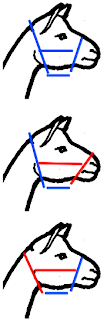 The image on the right illustrates the basic placement for a halter. The top image, all in blue, depicts a well fitting halter. Maybe a bit loose but not much (and it's the computer's fault not mine). The second head has a side piece that is too long and results in a nose piece that sits too low on the cartilage of the nose and may inhibit breathing. The third photo also has a long cheek piece which in this case results in the strap behind the ear slipping back. If this strap were to slip too far it would hold the head in a very uncomfortable position. Even with a well fitting halter this piece can occasionally slip down so be sure when playing with your goat that you are aware of your equipment and what it is doing and how it is working at all times.
 On one of my goat groups someone recently asked about fitting halters to Boers with extreme roman noses. To the left is a photo, if not of a Boer, of a roman nose. There seems to me to be no way you could get a halter made for dish nosed goats to fit a roman nose. Firstly the nose band needs to be significantly larger than for, say, a Saanen of the same size. Then also the distance from the behind- the-ear band to the nose band on both the side (A) and below (B) would, I imagine, be significantly shorter. I might also, now I am looking at this image more, more the connection of "A" to the nose band up a bit (not so much as to interfere with the eye but a little bit more to hold the nose band more securely.) Please note that I've never tried making a halter for a roman nosed goat so all this is just an educated guess... if you have a roman nosed goat you want a halter for I'd love to either make a halter for you or give you any guidance you wanted to to modify the instructions for a normal halter for a Boer.
Another thing I started thinking about when I was looking at photos of roman nosed boers online is that the bucks often have serious dew laps! I wonder how one could accommodate these in making a halter!?
Any thoughts?
Also in working on my website, Margaret Shackles, a friend/mentor of mine suggested I add a book section under resources. This is, of course, an excellent idea but I need your help to come up with useful, informative, even just amusing goat books you have and love! You can just send me the names or, even better, add a little review with information on why this book is useful.
Thanks,
M.
 The image on the right illustrates the basic placement for a halter. The top image, all in blue, depicts a well fitting halter. Maybe a bit loose but not much (and it's the computer's fault not mine). The second head has a side piece that is too long and results in a nose piece that sits too low on the cartilage of the nose and may inhibit breathing. The third photo also has a long cheek piece which in this case results in the strap behind the ear slipping back. If this strap were to slip too far it would hold the head in a very uncomfortable position. Even with a well fitting halter this piece can occasionally slip down so be sure when playing with your goat that you are aware of your equipment and what it is doing and how it is working at all times.
 On one of my goat groups someone recently asked about fitting halters to Boers with extreme roman noses. To the left is a photo, if not of a Boer, of a roman nose. There seems to me to be no way you could get a halter made for dish nosed goats to fit a roman nose. Firstly the nose band needs to be significantly larger than for, say, a Saanen of the same size. Then also the distance from the behind- the-ear band to the nose band on both the side (A) and below (B) would, I imagine, be significantly shorter. I might also, now I am looking at this image more, more the connection of "A" to the nose band up a bit (not so much as to interfere with the eye but a little bit more to hold the nose band more securely.) Please note that I've never tried making a halter for a roman nosed goat so all this is just an educated guess... if you have a roman nosed goat you want a halter for I'd love to either make a halter for you or give you any guidance you wanted to to modify the instructions for a normal halter for a Boer.
Another thing I started thinking about when I was looking at photos of roman nosed boers online is that the bucks often have serious dew laps! I wonder how one could accommodate these in making a halter!?
Any thoughts?
Also in working on my website, Margaret Shackles, a friend/mentor of mine suggested I add a book section under resources. This is, of course, an excellent idea but I need your help to come up with useful, informative, even just amusing goat books you have and love! You can just send me the names or, even better, add a little review with information on why this book is useful.
Thanks,
M.
Wednesday, October 12, 2011
I promise...
 ...that I will post something interesting and informative soon. My excuse is that I've been rather busy what with the PSAT this morning and intake for Animal Compassion Network this evening. Intake (for me) consists of holding cats/kittens while Margee, a very nice vet who I met this summer, draws blood, gives vaccines, de-worms and microchips them. Everyone there is really nice.
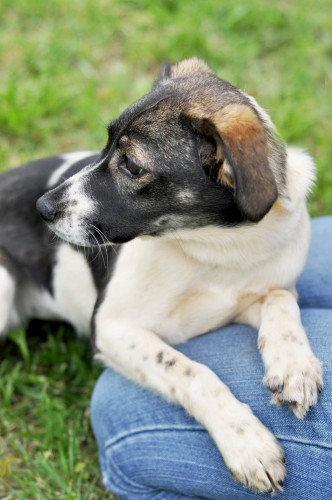
Anyway I've been doing school and that all day and I still haven't finished all the chemistry I need to but never mind... I'm too tired so here is a photo of our dog before we adopted her. :)
Good night,
Miranda
Monday, October 10, 2011
Too much energy?
I have been communicating with GoatSong ever since she got a halter from me (and it has been a great conversation.) In a recent e-mail she asked:
I thought there might be someone out there who was interested in my response so here it is:
"Re: standing still.... goodness... Merry has that problem sometimes... but I think he is more nervous than bored. I think I'd just be a lot more energetic and faster. What one Parelli thing I have says about Left Brain Extroverts (LBEs) which is I think what Heidi is, is
DO
- teach her something new at least once a week (probable more)
- Keep sessions active interesting and playful. use obstacles, become more imaginative ad when he's really playful, increase the pace and get him to do more.
- Mischief is her middle name; so give him things to do with that busy mind and mouth. This horse loves to play trick on you, so why not teach her some tricks on purpose?
- Use long lines- Give her room to move.
- praise a lot, have fun, lots of scratches and smiles she likes to have fun.
Don't
- Bore her with endless, mindless repetition. She is smart! When you know she's got it (even just a little bit) move on. You can always come back to it and add polish little by little.
- Slow calm riding (or playing) is not really this goat's dream. She wants to be active, go somewhere.
- Punish her (I know you know this one though)
So being more specific..... with the hind-quarters maybe give her a better visual/feel-able about where you want her front feet to stay and break up working on that with jumping/running/weaving etc. something active.
For instance. Teach her to put her from feet on a pedestal (preferably round maybe an old tire with the center filled with dirt.) Then you can do something like jump a jump, run between two poles, and then put her front feet on the pedestal and yield her hindquarters 1 step then stop doing that and go immediately on to something else. Don't let her drag you along. You go as fast/faster than she wants to go and for longer (but in a productive interesting way.).... if you see what I mean.
With the driving game (rhythmic pressure) I'd ask her to do more faster. Don't take as long for your phases. Of course it is a fine line between going fast enough to make it interesting and going to fast and dreadfully confusing her. Hopefully that helps you a bit.... gives you some ideas to try....let me know how it works! I've never personally had to deal with this so these are just ideas... :)"
hope you found that interesting/informative. Up next! Haltering and halter fitting.
M.
Sunday, October 9, 2011
Home again Home again...

It was a fun time though. Perfect weather, a good number of people, and pulp from apple juicing (to Merry's joy.) If you had been there you might periodically seen a goat, harnessed to a cart with a small child in it barreling down between the vendors to come to a grinding halt in front of the apple stand. It wasn't quite as out of control as it sounds. I was careful of the small ones. Actually, one of the first kids to have this experience called out to me as we were running "slow down slow down! you'll hurt the little house!" (the little house was a doll's house set up point out sustainability issues.)
What was really cool was talking to a man who had his two Suffolk Draft horses and was doing a logging demo. They were gorgeous and he also gave me a few tips on logging with goats! I hope to try it sometime in the near future.
More photos to follow when I get them....
M.
Subscribe to:
Posts (Atom)